1996
Walls (Circus)
Tom Petty
I didn’t discover Tom Petty or seek him out. I didn’t have a friend who introduced me to his music. Tom Petty is just kind of the air we breathe in America.
I grew up watching his videos. I was immersed in his singles. Everywhere the radio and MTV were, there was Tom Petty. Other bands and songwriters I loved, I had to go back and find them. I had to uncover them in the books and magazines I was reading or in my mom’s record collection. I had to order their CDs from BMG or Columbia House and delve into their music.
But I didn’t think I needed to buy a Tom Petty record to figure him out. He was just there, singing to me, and always had been.
When Full Moon Fever came out in 1989, it was the first time since I had become a sentient music-buying fan that I noticed Tom Petty and thought of him as a current musician to whom I should pay active attention. Sure, Bob Dylan and George Harrison considered the younger musician a peer in the Traveling Wilburys, but I didn’t think Petty’s music was deep or important. This guy wasn’t on the level of Paul Simon or Neil Young or Lou Reed. His lyrics weren’t going to be collected in any coffee table books.
I didn’t buy Full Moon Fever, but I loved the sound producer and ELO genius Jeff Lynne gave that record, and I never changed the channel when “Free Fallin’” or “I Won’t Back Down” came on. I loved the video for “A Face in the Crowd.” The same thing happened with Into the Great Wide Open. The title track and “Learning to Fly” were great, but I still didn’t buy the record.
In ’93, Tom Petty released his titanic Greatest Hits record. Even my brother bought that CD, but not me. “Mary Jane’s Last Dance” was probably my favorite song of his since “Refugee.” Every cover band I saw in college seemed required to play it. Still, I fundamentally thought of Tom Petty and the Heartbreakers as a singles band. And those hit singles were literally everywhere. I didn’t need to own them.
When Wildflowers came out and critics called it one of the best albums of his career, I checked it out. But like the A&R guy in “Great Wide Open,” I didn’t hear a single. I watched Dave Grohl drumming with the Heartbreakers on SNL, which made me wonder whether I should be more interested. I was not.
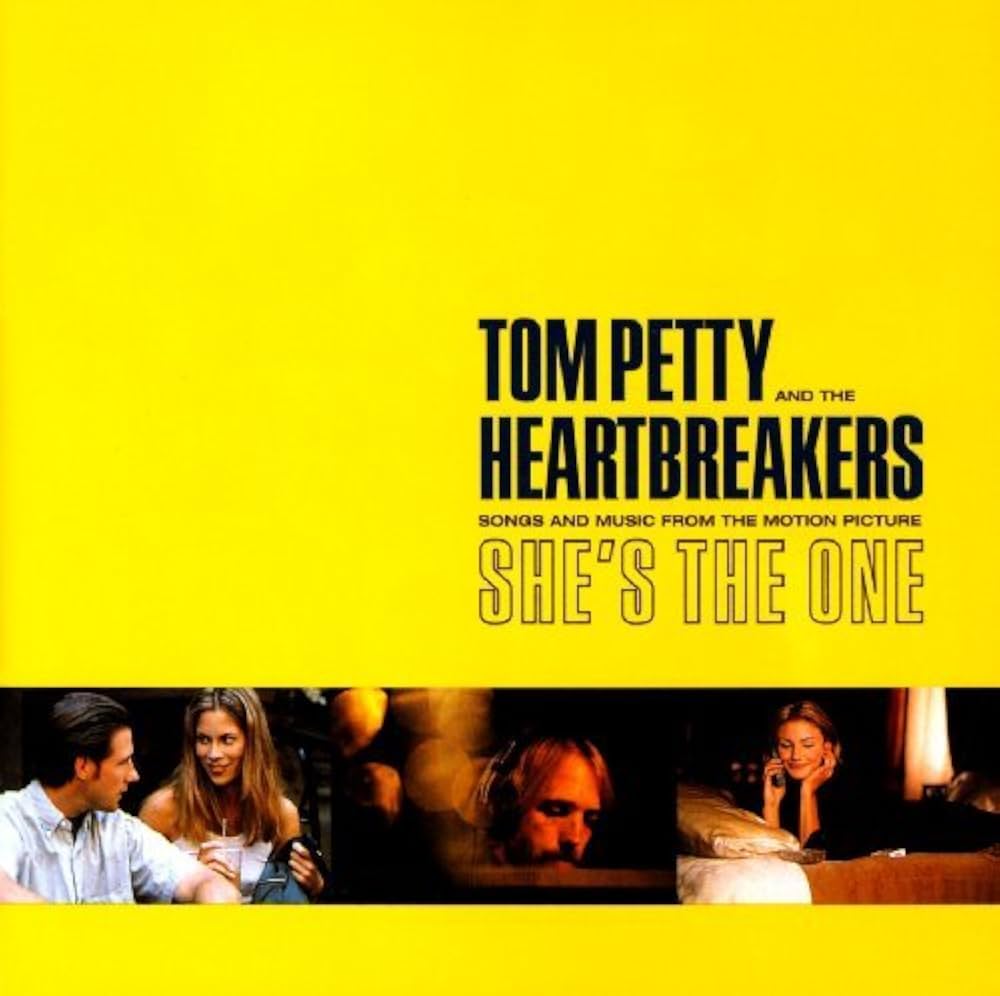
It wasn’t until 1996 that I bought my first Tom Petty album. It was the soundtrack to She’s the One, the now-all-but-forgotten Ed Burns romantic dramedy co-starring Jennifer Aniston. I thought the movie was okay at the time. I couldn’t tell you anything about it now. But working at the arthouse theater where the movie played, I got extended exposure to Tom Petty’s music for the movie. As soon as I heard “Walls,” the movie’s signature song and single release, I finally heard a Tom Petty piece I had to own.
I’m not sure what took me so long. But I think part of it was that I was becoming a songwriter myself by this time. I was starting a band. I had recorded dozens of songs on my Tascam 4-track cassette machine. And I realized I sounded more like Tom Petty than anyone else. I didn’t sing like him exactly. But even now, the way I put my songs together is a template I learned from Petty, with new elements I would eventually pick up from bands like Spoon and the Shins. Cowboy chords with big, memorable choruses—that’s what I was going for. And I was finally learning how hard it was to write the simple hit songs Tom Petty had been writing for more than 20 years at that point.
He didn’t do anything on “Walls” he hadn’t been doing for years. Although She’s the One is credited to the Heartbreakers, it was actually an extension of his nominal solo album, Wildflowers. It consisted of leftovers from those Rick Rubin-produced sessions. She’s the One sounds more playful and experimental in parts. It had a lot more reverb. And it featured left-field covers of Lucinda Williams and Beck (“Asshole” is from Beck’s One Foot in the Grave and features backing vocals from Fleetwood Mac’s Lindsey Buckingham). It’s also more slight than Wildflowers, with two of the songs, “Walls” and “Angel Dream,” appearing twice on the record.
So it’s not like Tom Petty had finally made his best album and now I was paying attention. Most Tom Petty fans would consider this album well down the list of his best work. What had changed was me. I was hearing Tom for the first time. The way he turns little strums or tight arpeggios into sturdy hooks. The way he uses simple words to describe universal emotions and builds whole worlds with his choruses. You read the lyrics and think, “There’s not much going on here.” But the meaning is in the way he sings the words. He sounds like he’s just talking to you, and he’s letting the details fall into the cracks of your mind. You get to do the rest.
“Half of me is ocean,” he sings, “and half of me is sky.” The part in between is the listener. Petty made iconic videos and now was scoring a movie. But the real movie is what you’re seeing in your head when he sings. That half-spoken voice is one-third of a holy trinity, with Benmont Tench’s keyboards and Mike Campbell’s guitar. Listen to the way Tom whispers before escalating into a series of increasingly urgent choruses before Tench and Campbell finally break the tension and trade solos in “Grew Up Fast.” It’s a microcosm of the Heartbreakers.
Petty had changed in one key way, and I thought it started back on Wildflowers. Petty’s lyrics had become less detailed and story-oriented. Petty had always had the ability to set the scene with painterly, specific detail. And he also wrote about women with uncommon empathy and perspective. But there’s no “American Girl” or “Mary Jane” or “Free Fallin’” on Wildflowers or She’s the One. Starting in ’94, and for the rest of his career, his songs are haunted by his failing marriage, memories of his early family life, and his turn toward substance abuse. There were fewer songs describing a scene outside of himself, and more that were vulnerable and autobiographical. Songs that just chronicle his emotions and memories as his relationships start to falter. Starting in the mid-90s, there’s less narrative and more songs written as dialogues between “I”/“me” and “you.”
It’s more solipsism than cinema by the time you get to Wildflowers and She’s the One. We’re getting the confessional, emo Tom Petty. And it should totally suck. But it doesn’t. And I think it’s his voice that holds it together. That voice, borrowed from the Byrds and Dylan and George Harrison and smoothed out into a warm, winking smile, had always invited us into Petty’s songs of America, and now it was inviting us into his personal meltdowns, yearnings, and anxieties.
Petty’s baritone/tenor has a way of putting you at ease and then making a joke or a threat that can surprise you with its sudden sharpness. One of my favorite moments in music is when Tom Petty sings in “Walls,” in apparent contradiction, “If I never do nothing, I’ll get you back someday.” It’s a double negative. A worthless promise. An empty IOU. A declaration of asymptotic love that might one day come near, even if it never quite takes you all the way. In the earlier part of the verse, he’s lazily drawling, but at the moment he sings “get you back,” there’s a clutch of ferocity that could be hopeful or harmful.
It’s hard to explain, but there are depths to Petty’s music that make him just as valuable to the American songbook as Dylan or Paul Simon or Lou Reed. You can’t grasp that depth on the page; you have to listen to Petty sing it. But once you do, you find yourself singing his great lines to yourself all the time. Singing them the way Tom sings them.
“Who knows, maybe you were kidnapped, tied up, taken away, and held for ransom?”
“I’m learning to fly, but I ain’t got wings / Coming down is the hardest thing.”
“But when she puts her arms around me / I can somehow rise above it.”
“You take it on faith, you take it to the heart / The waiting is the hardest part.”
“But remember, good love is hard to find.”
“And I’m a bad boy ‘cause I don’t even miss her / I’m a bad boy for breakin’ her heart.”
“Well, she was an American girl / raised on promises.”
Okay, so that last one’s so good, it even looks good on paper. Sometimes now, I think Tom Petty’s songbook is the real great American novel, and that’s the first line. Up there with Dickens and Dostoyevsky among the best first lines ever. He’s written so many hits, they kind of have a cumulative effect. Collected not on your table, but stuck there in your head. And maybe in your heart.
Favorite Lyrics:
You’ve got a heart so big
It could crush this town
And I can’t hold out forever
Even walls fall down